Paddock Paradise
The Paddock Paradise system offers a holistic approach to horse management, that addresses the physical, mental, and social needs of horses in a way that more closely aligns with their natural behaviors and instincts. By creating an environment that encourages movement, foraging, and social interaction, Paddock Paradise promotes healthier, happier, and more balanced horses.
This ground-breaking system has many benefits including:
- provides a more stimulating environment for the horse which discourages vices
- encourages more movement which benefits overall health of the horse
- enables easier grazing management
"The key to having physically and mentally healthier horses"
Jaime Jackson
How did Pasture Paradise Evolve?
Jaime Jackson, a former farrier turned natural hoof care practitioner and advocate for barefoot hoof care, developed the Paddock Paradise concept after researching the free-roaming American Mustangs of the Great Basin. His studies revealed that these horses travel long distances daily, foraging for food and water.
Jackson observed that the constant movement over varied terrain contributed to the overall health and soundness of these wild horses. He theorized that mimicking these natural conditions for domesticated horses could prevent many of the common hoof and health problems they face such as laminitis, navicular and colic.
Jaime published his first book in 1992, The Natural Horse: Lessons from the Wild which documented his wild horse studies and offered insights as to how we could better meet the biological needs of our domestic horses.
In 1999 he went on to write the Horse Owners Guide to Natural Hoof Care which went into more detail regarding his trim methods.
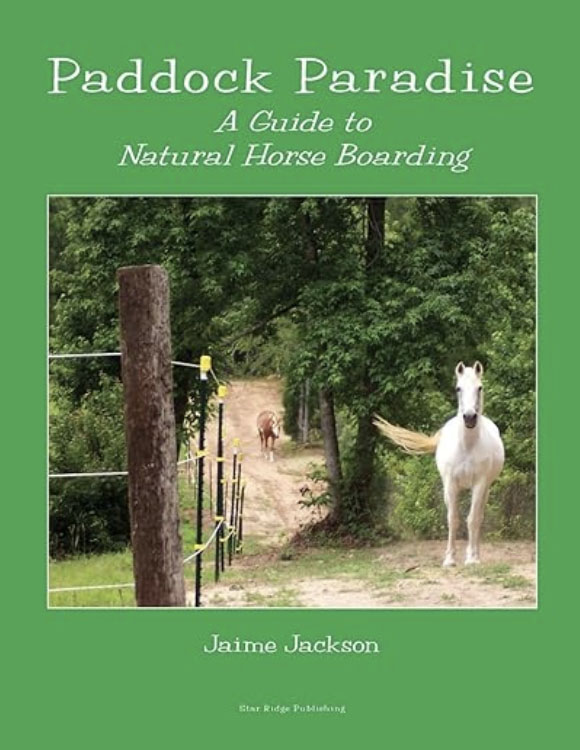
Paddock Paradise: A Guide to Natural Horse Boarding was published in 2007.
Here's How Pasture Paradise Works:
|
The central feature of a Paddock Paradise is a track system that replaces a traditional pasture or paddock. The track system’s design encourages horses to move continuously throughout the day, mimicking the natural foraging patterns of their wild counterparts who travel up to 18 miles per day foraging for food and water. Paddock Paradise aims to create a stimulating and diverse environment that more closely mirrors a horse's natural habitat.
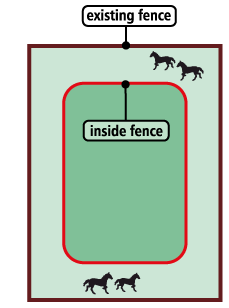
A basic track can be created by simply running an additional fence, typically electric, inside the perimeter fence of the existing pasture, to form a lane or pathway. This encourages the horses to walk more to find food, water, and shelter, increasing natural movement and exercise. The narrower the track, the more the horses will move. However, the track should always be wide enough to accommodate the number of horses on it in order to prevent dominant horses from cornering others. Integrating natural features like creeks for soaking hooves, gravel and rocky areas to toughen hooves, and hills for conditioning along with the consistent movement, helps stimulate hoof growth and prevent common hoof problems. Different surfaces such as pea gravel, rocks, sand, or packed dirt along the track provide variety and promote hoof wear. |
 |
Here's How I Made A Paddock Paradise:
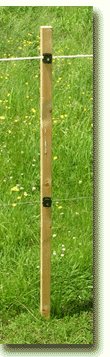 |
When I moved to this property, in 2009, there were no existing fences so I was able to design the track system from scratch. There was approximately 30 acres of pasture but with only 4 horses and 2 ponies I needed to reduce the amount of grazing whilst keeping the track as long as possible to encourage maximum movement. Initially I used both plastic and metal step-in electric fence posts for the inside and outside fences. However, I soon found that the shop-bought posts were not adequate for a Canadian winter! With up to 3 feet of snow the posts would disappear as they were only be 3 ft long, and then the horses could just step over the fence, not good... So after some brainstorming I made my own using 6" x 2" x 10ft spruce, cutting it to 5ft lengths, then cutting into 3 to end up with 2" x 2" x 5ft posts. Then I cut a spike onto one end to make them easier to pound into the ground and added 2 plastic electric fence insulators (see pic - left). The total cost per post worked out to around $1 (CAN) which way much cheaper than store bought ones. |
I used the electric fence poly rope on the top of the outside fence, with electric fence wire on the bottom and inside track. The rope is better than tape as it doesn't get twisted or flap in the wind but is still very visible. I initially tied orange surveyors tape all along the wire to make it more visible but it didn't stay put for long as the wind bunched it up by the posts. But it lasted long enough for the horses to become familiar with the new layout. I did use the lighter gauge wire that will break relatively easily, just in case they should run into it.
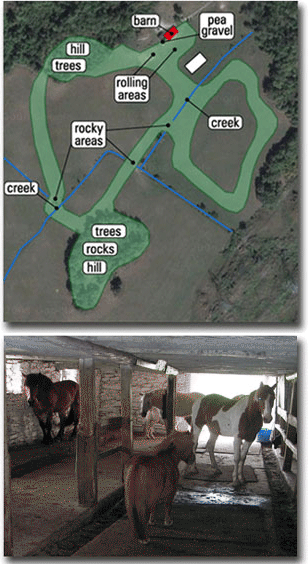
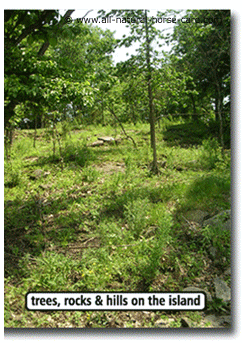
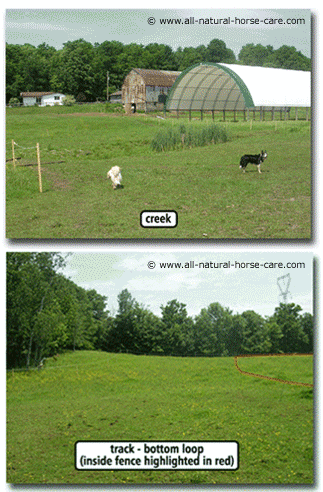
The track incorporates the natural features of the property: a creek for hoof soaking; areas of gravel and rock to toughen up the hooves; hills for conditioning; trees for scratching and shade; and two mud areas designated for rolling. Photos of these features can be seen below.
|
Here is an aerial view of my Paddock Paradise track (right). As you can see it is quite long, with two loops. I avoided creating sharp corners so that there is a better flow - Monty, a young Paint x TB considered the loop on the bottom right as his own personal race track...he loved to run like the wind down the straight sections. I was amazed by how much more they moved after implementing the track system. They all looked as if they are worked regularly which makes me feel less guilty for not having time to ride as often as I'd like! In the winter I utilized horse slow feeders which ensured that the horses have regulated access to free choice hay. I am totally convinced by the benefits of Paddock Paradise and highly recommend you try it for your horses. |
 |
 |
 |
The Paddock Paradise book provides lots more information and ideas for customizing your track.
 |
Paddock Paradise
I highly recommend you read the Paddock Paradise book as it contains lots of examples and ideas for making your track as stimulating as possible for your horse. Click on this link to purchase the book: |
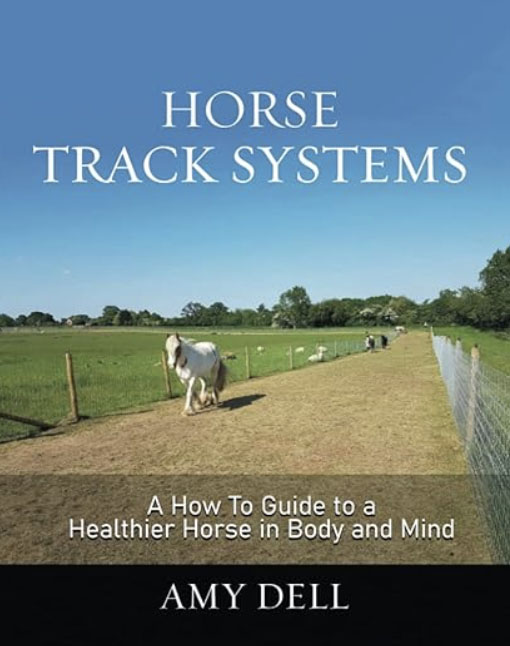 Horse Track Systems by Amy Dell Horse Track Systems by Amy Dell |
Horse Track Systems -
|
More Paddock Paradise Examples
Here are a few more Pasture Paradise examples in use - click on the following links to view and scroll down to submit your pasture paradise:
Mustang Mountain and Missouri Paradise
Mustang Mountain, otherwise known as Stars Rest, is located on the side of a mountain in northeastern New Mexico. It is at 7,600' elevation and the terrain varies from steep granite bluff to rolling sandy bottom. It is surrounded by ponderosa pine forest and there is no pasture land.
Stars Rest's formerly wild mustangs are fed free choice local grass hay and just enough beet pulp to provide them with necessary supplements. They are all kept barefoot and have no difficulty climbing up and even galloping over the rugged mountain terrain. In spite of dire predictions of lameness and injury from keeping horses on this rugged piece of land, our little bachelor band has just gotten stronger, healthier and happier.
Missouri Paradise consists of approximately 12 acres made up of mostly hardwood forest along with 4 acres of pasture and is home to 4 horses.
Wisconsin Paradise
This site shows how a single paddock can be altered to create more interest and encourage the horses to move more. A track has been built around the edge and rock has been added to give a more varied terrain.
Want to share your paddock paradise?
Help others by sharing information and photos of your Paddock Paradise.
Other Visitor's Paddock Paradises
Click on the links below to see contributions from other visitors to this page...
Brittany France 
Still work in progress but completed 800 meters on a old French trotting track so ground is great for barefoot. Still want to extend it as got 17 acres …
Near Penrith, Cumbria, UK
I hasten to say that my track is still being developed and I need to add much more texture to help condition their feet and combat the slippyness when …
Windsor, NY
Horsey Heaven, our PP model, is on part of 7.9 acres in upstate New York. We have several features available to us naturally, which include rocky areas, …
Cheshire UK
We only have 4 acres for my 2 horses however by using the paddock paradise set up our horses remain barefoot and look healthier than ever.
I have used …
Provence, France Not rated yet
A Paddock Paradise, naturally organized around a forest.
Christchurch New Zealand Not rated yet
I have set up a track in a large paddock with largely sprayed off grass, so half and half grass/bare dirt. It is very lush where we live with clover/rye …
High Desert Southern California Not rated yet
I am so glad to see more people demonstrating that a lane system is an important and proven alternative horse keeping method.
We are ten years on the …
Return from Paddock Paradise to Natural Boarding