All Natural Horse Care logo
All Natural Horse Care image

Barefoot hoof diagrams

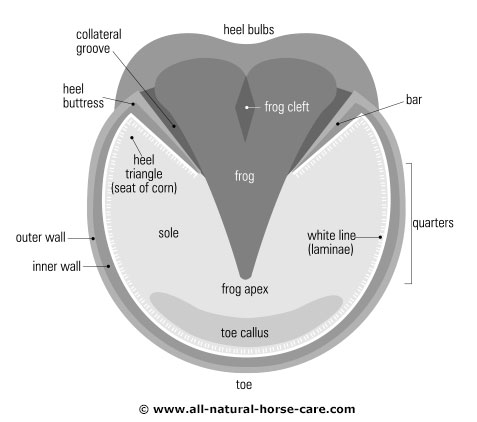
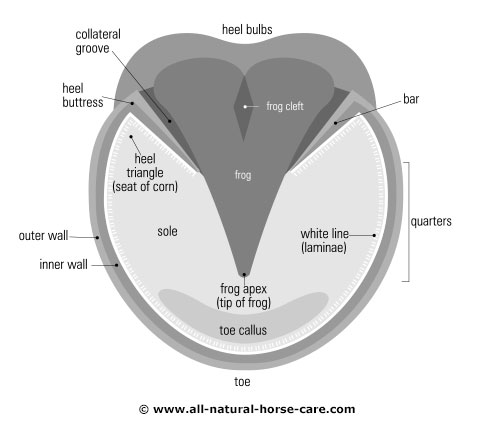
Below are some barefoot hoof diagrams to give you an idea of what the shape of the "ideal" hoof should look like. The parts of the hoof are labeled for reference.

Note: Healthy hooves can vary depending on the environment the horse is living in and the terrain they regularly encounter.

Sole view of a front hoof

Note the following points:
  • Wide, fat frog.
  • Tight white line.
  • Strong, thick hoof walls - with the inner wall being thicker.
  • Bars end approximately halfway down the frog.
  • The heel buttresses are back towards the rear of the frog.
  • The hoof ratio is 65:35 (from the rear of the hoof to the widest point; and from the widest point to the break over).
horse hoof sole
© Jenny Edwards 2006
www.jmedesign.co.uk

Sole view of a rear hoof

The rear hoof is more oblong in shape and has a slightly pointed toe compared to the front hoof. This is because the rear hooves are used to propel the horse forward and so the point helps the hoof dig into the ground to provide more push.

horse rear hoof
© Jenny Edwards 2006
www.jmedesign.co.uk

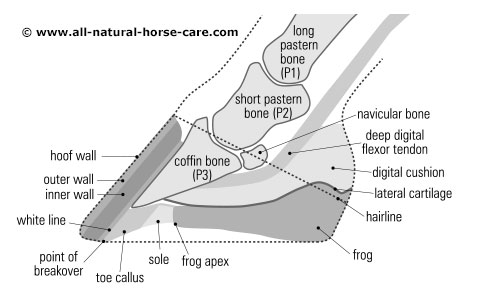
Side view of the hoof capsule


horse hoof side
© Jenny Edwards 2006
www.jmedesign.co.uk


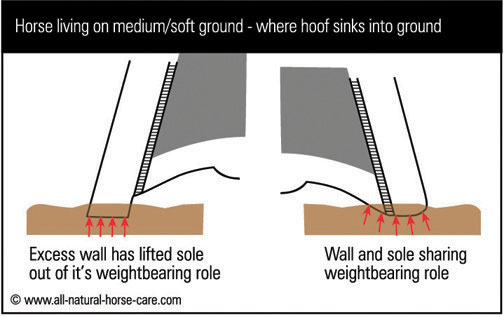
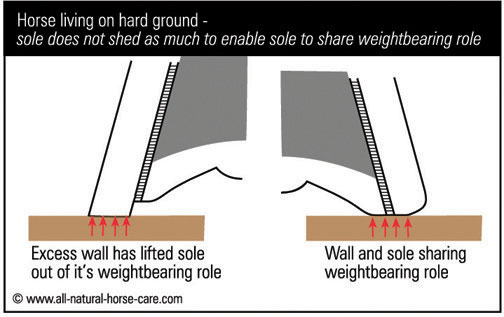
Weightbearing - the true role of the wall and sole

Contrary to popular belief, the hoof wall should not be the only structure to bear the weight of the horse. This is called peripheral loading and it puts way too much stress on the laminar connection and has a dramatic effect on the blood supply to the hoof. Dr Robert Bowker VMD, PhD recently did research on this and found that on a:
  • correctly trimmed Bare foot: blood flow continues between heartbeats
  • Shod foot: blood stops between heartbeats and blood does not reach small blood vessels.
  • Laminitic foot: blood stops and backs up between heartbeats
The diagrams below show how the hoof should be trimmed (images on right hand side of box) so that both the wall and the sole bear weight.

hoof weightbearing on soft ground hoof weightbearing on hard ground

Return from Barefoot Hoof Diagrams to Natural Hoofcare


SBI! Case Studies

Like the information on this site?

ANHC Ebook

Downloadable ebook now available containing all the information on this site - over 100 pages - in an easy to print and navigate offline version.

Click here for more information

Trimming Service and Trim Clinics

click here to find out more about our trimming service

click here to find out more about learning how to trim by attending a trim clinic


ADD TO YOUR SOCIAL BOOKMARKS: add to BlinkBlink add to Del.icio.usDel.icio.us add to DiggDigg
add to FurlFurl add to GoogleGoogle add to SimpySimpy add to SpurlSpurl Bookmark at TechnoratiTechnorati add to YahooY! MyWeb
| Homepage | Natural Health | Natural Lifestyle | Natural Hoofcare | Natural Horsemanship |

Copyright© 2008. All rights reserved. No part of this website may be reproduced without the written permission of the publisher and/or authors. The information contained within these pages is intended for educational purposes only, and not for diagnosing or medicinally prescribing in any way. Readers are cautioned to seek expert advice from a qualified health professional before pursuing any form of treatment for their animals. Opinions expressed herein are those of the authors and do not necessarily reflect those of the publisher.
Return to top

Website designed and maintained by Design Image